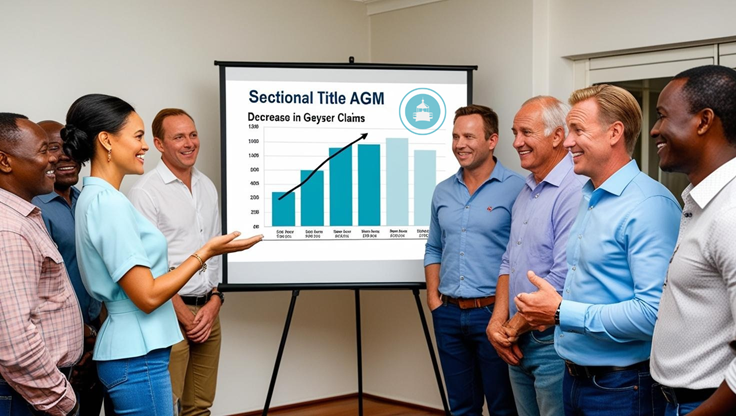
In the insurance industry, we often say the proof of the pudding is in the eating. When managing geyser claims, the proof is undeniably in the statistics. Let’s explore how a well-implemented mitigation strategy transformed geyser management for two sizable sectional title schemes.
Setting the scene – The challenge of geyser claims
Five years ago, two schemes, each with approximately 500 units, faced a common issue: an overwhelming number of geyser callouts and costly replacements. At the time, for every ten callouts, seven resulted in geyser replacements, while only three were repairable.
Why was this happening?
In our view, there were three main reasons:
- Profit motivation: Plumbers often recommended replacements over repairs because it was more profitable.
- Owner satisfaction: Homeowners welcomed new geysers, especially when insurance covered the cost.
- Incentives: To put it nicely, in some cases, managers are rewarded for referring geyser business to certain contractors. This is usually priced into the cost.
The mitigation plan
Enter a dedicated call centre – best usually the insurer’s appointed contractor or call centre. In these two cases, CIA Assist in collaboration with 0861WaterLite. The aim was to implement a more transparent, at-arms-length, cost-effective solution, prioritising repairs over replacements where possible.
Immediate results – A statistical shift
The results were almost instant and continued for a full five years, and beyond. The introduction of the call centre flipped the script. Instead of seven replacements and three repairs per 10 callouts, the numbers reversed. Now, seven repairs occurred for every three replacements. This fundamental change significantly reduced costs and improved the claims ratio for insurers.
A five-year retrospective
To illustrate the long-term impact, let’s compare the data from 2019 with the 2023 – 2024 statistics.
We call the two schemes “Scheme A” and “Scheme K”:
2019 (Before the plan)
- Scheme A: 27% repairs, 73% replacements
- Scheme K: 31% repairs, 69% replacements
- Average: 29% repairs, 71% replacements
2023-2024 (After the plan)
- Scheme A: 65%-66% repairs
- Scheme K: 58%-67% repairs
- Average: 63% repairs, 37% replacements
Even five years later, with older geysers that might typically warrant more replacements, the repair-to-replacement ratio remained favourable.
What these numbers tell us
This statistical turnaround highlights the effectiveness of the mitigation strategy:
- Cost savings: By reducing unnecessary replacements, insurers save significantly.
- Improved transparency: A dedicated call centre ensures honest assessments as the call centre operates for the insurer and away from the incentives.
- Reduced claims ratios: Better management of claims strengthens the overall insurance model. By reducing claims, policies become more sustainable, and premiums are kept down.
- The takeaway: The data doesn’t lie. A dedicated mitigation plan, particularly one leveraging a call centre like CIA Assist and 0861Waterlite, is a game-changer for geyser claims management. It’s a testament to how innovation and strategy can transform operational efficiency in the insurance sector.
Author: Mike Addison
Addsure is a leading sectional title insurance broker. Get fit and proper advice from advisors who understand sectional title.